Vatican Museums

Bramante Staircase tickets

Included with Vatican Museums tickets

Timings

RECOMMENDED DURATION

3 hours

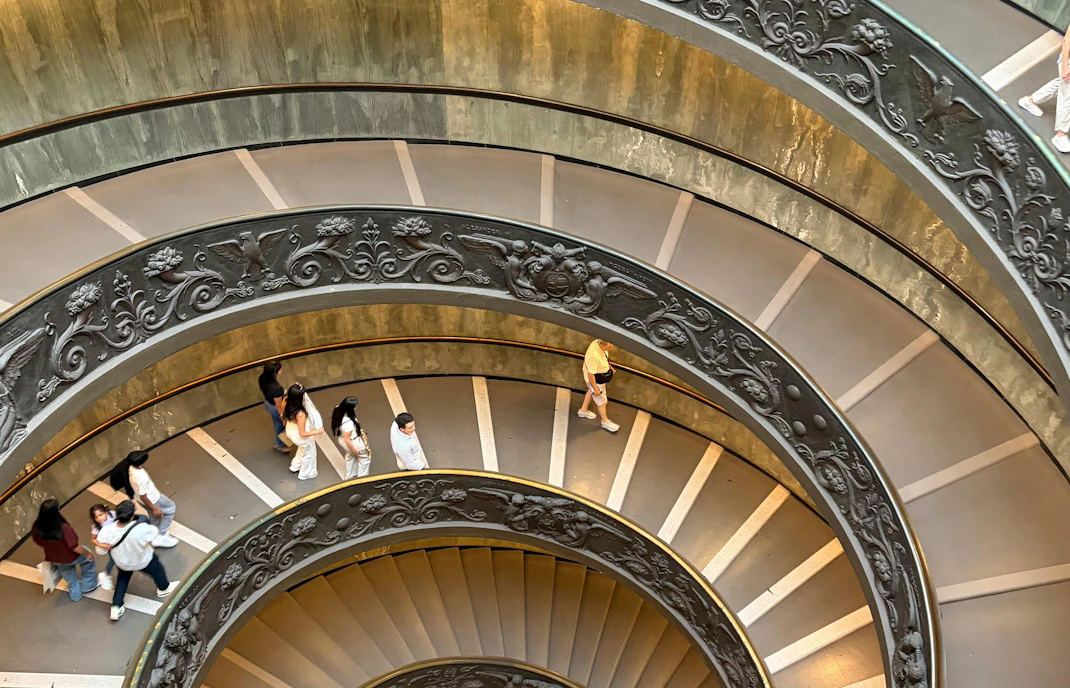
Bramante Staircase spiral inside the Vatican Museums

Reviews

Loved by 51 million+
Trustpilot rating: 4.5 out of 5

Rosalie F

New Zealand
Solo
Last week

+2 more

I was blown away, because of the height and magnificence of the dome, as I chose to go up there from the outside entrance rather than going into the basilica first. What a great way to be introduced to this architectural beauty! The Headout instructions far surpassed another company's directions!

Sarah M

United Kingdom
Solo
Last week
Well organised, easy to find, very clear instructions and helpful staff. Absolutely stunning place to visit. Brilliant value for money.

Mrs Zoe S

Family
Last week
#All I can say is amazing. Veronica was a brilliant guide, full of information and also made sure I was ok as it was so hot. Would recommend 100% 10/10 ⭐️

Patrick H

United States
Group
Last week

+5 more

There was a slight mix-up when we arrived for our tour - so the 'headout' team had to place our group of 3 with a different tour group with a guide from another agency (Tix & Tours). Our new guide was absolutley EXCELLENT! She was extremely knowledgeable as she explained the history and meaning behind what we were seeing. She also had a very easy going sense of humor and included anecdotes and additional color surrounding the various stories that added to the enjoymenmt of the tour. Because of the 'change' in tour groups...there was a slight hiccup with our tickets when we rtied to access the dome. Our guide stayed with us - translating with the guard then reaching out to the Tour company on her side to work through the problem and ensure that we were able to access the dome. We were extremely grateful as without her - we would have been denied access to the dome which was a highlight of the tour. On a scale of 1 to 10 - she was a 14! She quite literally made our trip!

Gedeon T

Ivory Coast
Couple
Last week

+1 more

Our guide, Catherine, was very professional—I’d even call her a walking encyclopedia. I highly recommend her to French-speaking visitors. She took us on a journey through time.

Pam B

United States
Group
Last week
Fantastic tour. Very knowledgable guide. The chapel was beyond description very spiritual. The tombs were a wonderful surprise. Our guide was wonderful

Carlotta A

Group
Last week
At the meeting point, the staff were helpful, clear, and friendly. A representative gave us our tickets and escorted us right to the entrance—this is an incredible ticket because it lets you skip the very long line outside. The guy took us right up to the turnstiles. A must-have ticket—highly recommended for everyone! The Vatican Museums are very large. I recommend the Egyptian Hall, the Map Room, the Raphael Rooms, and of course Michelangelo’s true masterpiece: The Last Judgment.

Rodney W

United States
Couple
Last week

+1 more

Our Catacombs tour was a great experience. Maria is an intelligent and funny guide. She is well rehearsed in the history of the area. She was captivatingly interesting to listen to. She was even kind enough to give additional directions to the subway at the end. We definitely recommend this tour to anyone wanting to see the Catacombs! Although no pictures are permitted in the catacombs there is plenty of other areas to take photos for memories.

Top things to do in Rome

Overview

  • Access: The modern spiral by the exit is included; the original is not publicly accessible
  • Separate ticket: Not required for the modern staircase
  • When you'll see it: At the very end of the route, near the exit
  • Visit duration: 2 to 5 min
  • Best time: Whenever you reach the exit; quietest at opening or late in the day
  • Restrictions: Viewed and descended, not closed off. No flash.

The Bramante Staircase most visitors mean — the modern spiral exit inside the Vatican Museums — is included with all Vatican Museums tickets. No separate ticket is needed. You’ll reach it at the very end of the museum route as you descend toward the exit; the original 16th-century Bramante Staircase is not on the standard path and appears only on restricted special-access visits. Book skip-the-line or early-entry tickets so you reach it after the main galleries with time to stop, look up, and photograph the full spiral.

How to best experience Bramante Staircase

Best time to visit

First entry on a weekday works best. You’ll usually reach the staircase before the biggest late-morning exit wave, which gives you more space to pause and frame the spiral properly. Midday museum slots bring you there with the heaviest outflow, so don’t choose them if the staircase matters to you.

How long to spend

Self-guided: 5–10 minutes is realistic. With a guide or special-access context, 10–15 minutes lets you study the full double helix from above and halfway down. If you treat it as just an exit, you’ll walk through without noticing the geometry.

Where it fits in your itinerary

It comes at the end of a long museum visit, usually after the major galleries and the Sistine Chapel. Budget 2–3 hours before you reach it. Save a little energy for the last descent, or it will blur into the exit flow.

Crowd patterns

The staircase gets busiest from 11am–2pm, when multiple museum entry waves reach the exit together. That means constant movement and less room to pause for photos. Earlier museum slots usually give you a calmer descent, especially on weekdays.

What to prioritize if time is short

If you only have a few minutes, stop first on the upper landing and look into the center of the spiral. Then glance back halfway down for the bronze rail pattern and symmetry. Skip repeated photo attempts; one high angle and one mid-ramp view are enough.

Common mistakes to avoid

Most visitors confuse the famous exit ramp with Bramante’s original 16th-century staircase and leave disappointed. Set expectations: the standard route shows the later staircase inspired by Bramante. Another mistake is walking straight down without pausing safely for one full overhead view.

Best tickets to experience Bramante Staircase

Ticket typeWhy choose it

Skip-the-line

Shorten the entrance wait so you reach the staircase with energy left for the museum’s final stretch.

Guided tour

Understand the route before you reach the exit, so the staircase feels intentional, not incidental.

Early morning

Reach the descent before the heaviest mid-day flow and photograph the spiral with less crowd pressure.

Why it’s worth seeing

What makes this staircase irreplaceable is that it turns the museum exit into one last designed moment rather than a corridor out. Most people searching for the Bramante Staircase Vatican are actually picturing Giuseppe Momo’s 1932 double-helix ramp, not Donato Bramante’s original early-16th-century spiral. That distinction matters because it changes what you look for: not a hidden relic, but a working piece of museum architecture built to be read in motion and from above.

The double-helix ramp

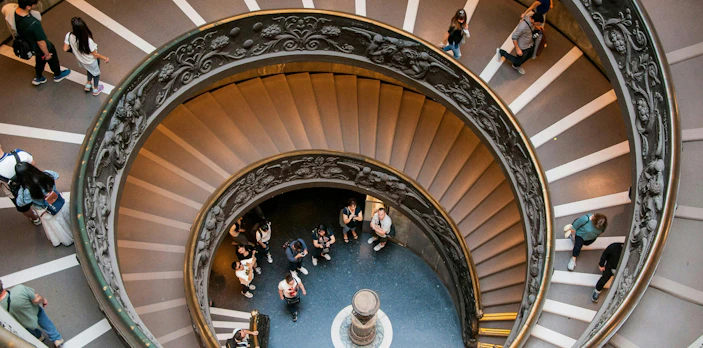
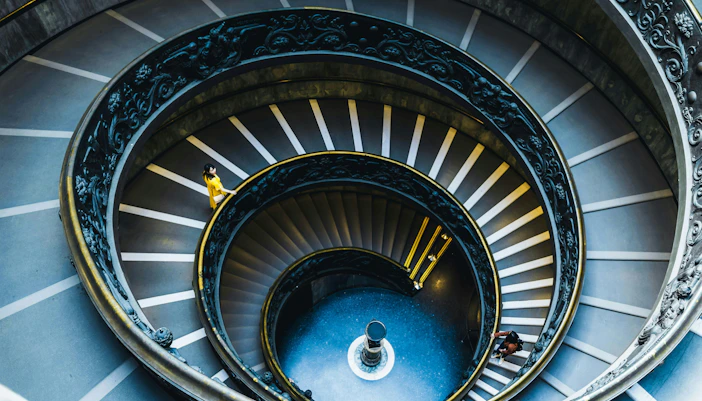
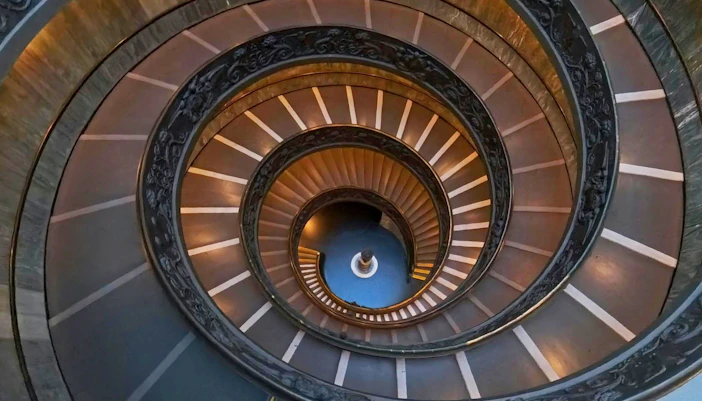
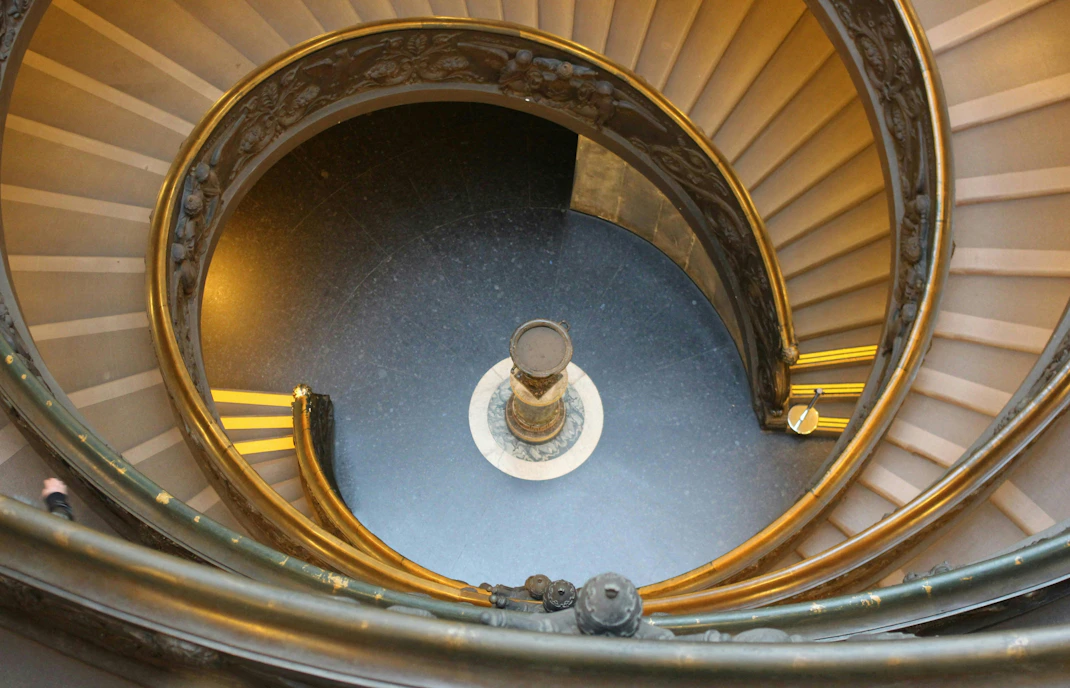
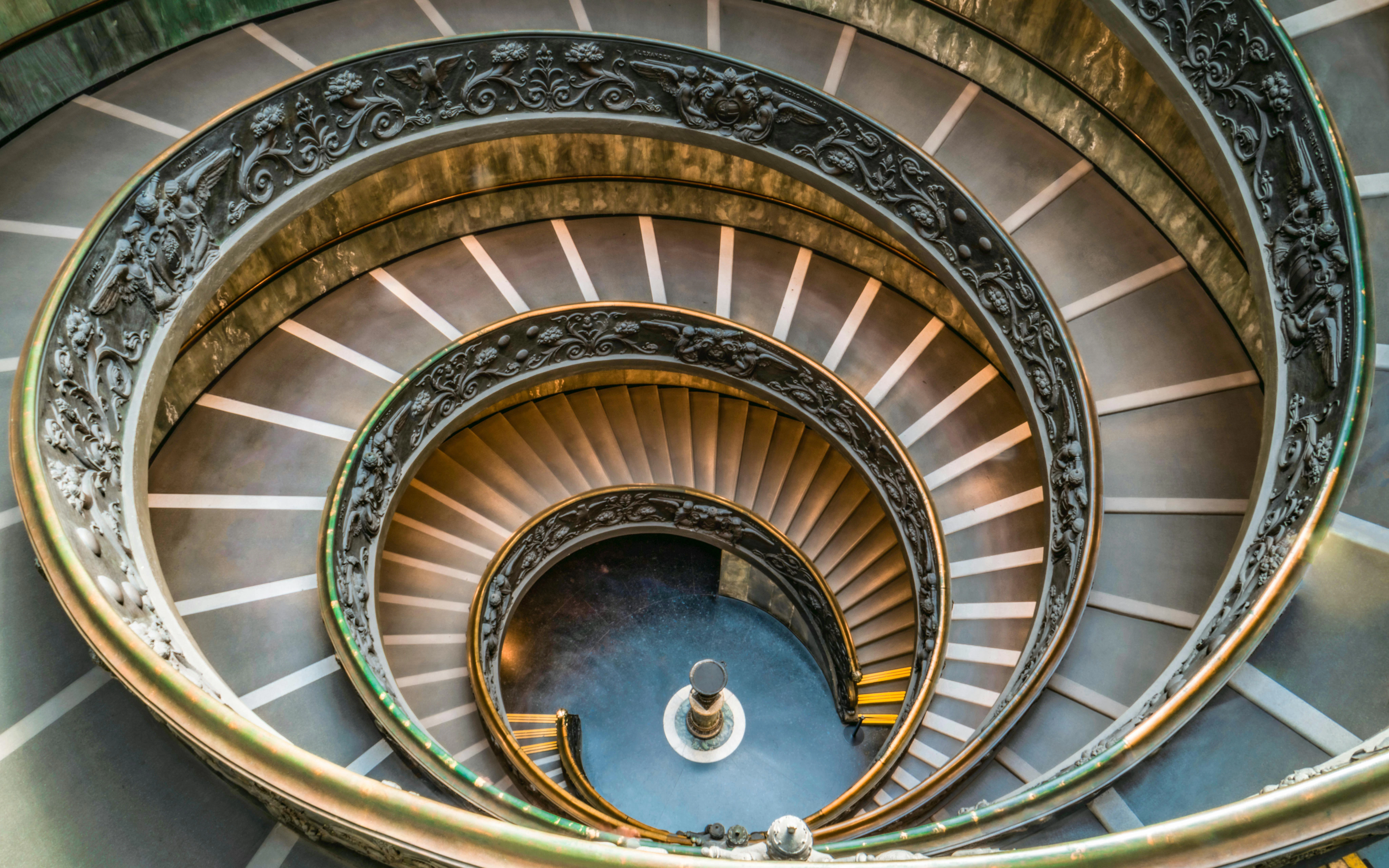
Built in 1932 by Giuseppe Momo, this is the staircase most visitors see. Stand at the top landing and look into the central void to read the two interlocking spirals at once. Its broad sloped ramps were designed for smooth circulation, which is why it feels more like a flowing architectural gesture than a conventional stair.
The bronze balustrade

As you begin descending, look at the bronze rail on either side rather than only into the center. The repeating pattern tightens as the curve turns, making the ramp feel almost mechanical. This detailing is what gives the staircase its photographic rhythm from mid-level.
The overhead view

The best view is not from the bottom but from the highest point where you can safely stop without blocking traffic. From there, the layered circles compress into a clean geometric image. It’s the single angle that explains why this staircase became one of the museum’s most reproduced interiors.

Notable figures

Giuseppe Momo | Architect

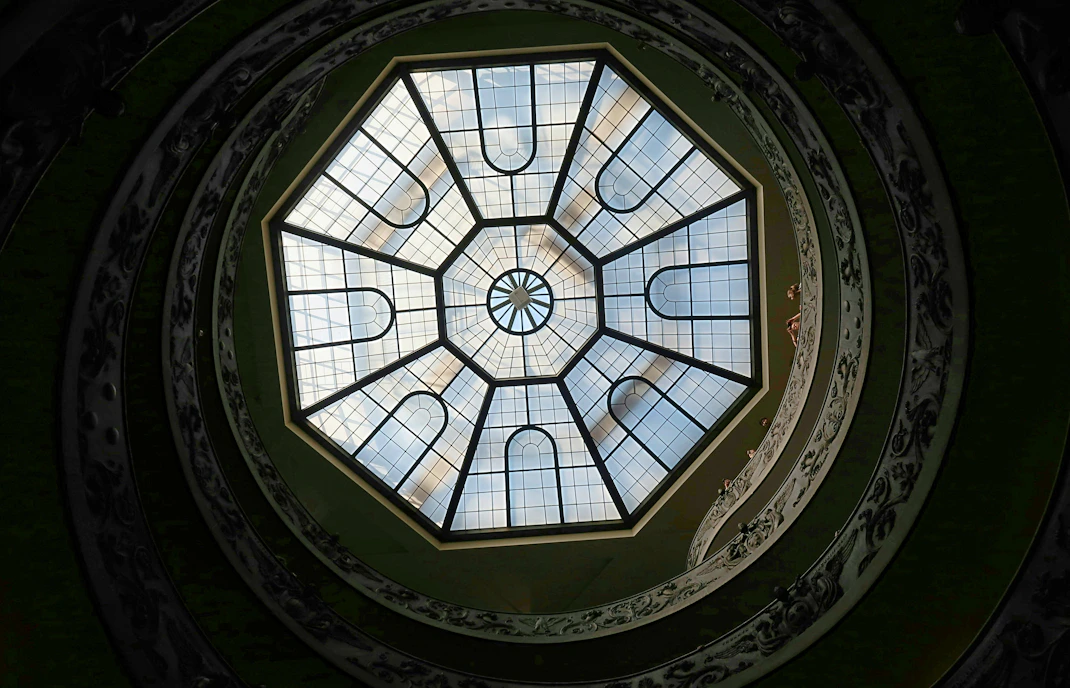
Giuseppe Momo (1875 to 1940) was an Italian architect and engineer who designed the spiral staircase visitors see at the Vatican Museums today. Built in 1932 for Pope Pius XI, it sits near the exit and takes the form of a double helix, two intertwined ramps that let people ascend and descend without crossing paths. Its sweeping, photogenic curve beneath a glass dome has made it one of the most photographed features of the museums. Though widely called the Bramante Staircase, it is properly Momo's work, an homage to the earlier design rather than the original.

Donato Bramante | Architect

DDonato Bramante (1444 to 1514) was one of the great architects of the High Renaissance, best known for his designs at the Vatican and the original plan for St. Peter's Basilica. Around 1505 he built a spiral staircase for Pope Julius II, a gently ramped helix designed so that pack animals could climb it. This original Bramante Staircase still exists but lies in a restricted area, off the standard visitor route. It inspired Giuseppe Momo's 1932 design, which is why the modern staircase is so often, if inaccurately, called the Bramante. Bramante's influence on Western architecture was profound.

Section 8 — Know before you go

  • Hours: Check current open and close times for your date on the Vatican Museums website.
  • Open days: Standard admission runs Monday to Saturday.
  • Entry system: All visits use timed entry, and late arrivals can be denied.
  • Arrival buffer: Arrive 15–30 minutes early, depending on your ticket or tour.
  • Closures: Sundays, some Vatican holidays, and event-driven section closures apply.
  • Address: Vatican Museums entrance, Viale Vaticano, Vatican City.
  • Nearest metro: Ottaviano and Cipro on Line A; each is about a 10-minute walk.
  • Entry point: Enter from Viale Vaticano, not through St. Peter’s Square.
  • Position in route: The staircase comes at the very end of the museum route.
  • Direct access: No independent entrance is available; you must follow the museum circuit.
  • Wheelchair access: Since the stairs must be climbed or descended physically, it is not suitable for wheelchair users or people with limited mobility.
  • Original staircase: The original Bramante Staircase is not the standard accessible route and may be restricted.
  • Required: Shoulders, knees, and back must be covered to enter the Vatican Museums route.
  • Not permitted: Sleeveless tops, short shorts, mini skirts, and revealing clothing.
  • Where it matters: Dress code is enforced before you can reach the staircase, because it sits inside the museum route.
  • Enforcement: Non-compliant visitors can be refused entry.
  • Best backup: Bring a light layer or scarf if your outfit is borderline.
  • Security: Airport-style screening is mandatory for all visitors.
  • Large bags: Suitcases and bulky bags are not permitted; use the cloakroom when available.
  • Sistine Chapel rule: Photography and talking restrictions apply there before you continue toward the exit staircase.
  • Late arrival: Timed tickets are linked to a set slot, and latecomers may be denied entry.
  • Closures: The Vatican can close sections at short notice for religious or institutional events.
  • Walking load: Expect a long museum route before you reach the staircase.
  • Standing time: Most visits involve 2–3 hours of standing and slow walking.
  • Stair/ramp type: The staircase most visitors use is a broad sloped ramp, not a steep narrow stair.
  • Difficulty: Easy to moderate for most visitors once inside.
  • Alternative: Ask staff for elevator options if continuous walking is difficult.

Frequently asked questions about the Bramante staircase

The modern exit staircase commonly called the Bramante Staircase is included with every valid Vatican Museums ticket. No separate ticket exists.

More reads